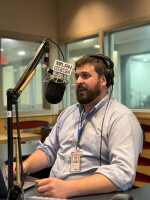
Emmanuel George is one of Broward county’s preeminent historians. Through his work as the community liaison at the Old Dillard School and museum and on the instagram account Black Broward, George tells the little-known stories of some of Broward most influential black people, places and events.
Now, alongside his frequent collaborator David Paulo, he's written a book, Broward Chronicles: A Retrospective Volume One.
The book explores key figures in Broward’s Black history like Esther Rolle, the daughter of Bahamian immigrants who went on to achieve fame in Hollywood, and Von D. Mizell, who established the area's first hospital that would treat Black patients. But it also dives into lesser known figures — and George says those smaller stories are key to having a holistic understanding of Black history in Broward.
“We're not gonna be able to get the full grasp of Broward history because so much history has been lost over the years. But the goal of it is to make sure that there are as many pieces to the puzzle — even though there's pieces missing— that you're still gonna be able to grasp what the picture shows,” George said.
WLRN's Carlton Gillespie sat down with George to talk about the new book.
This interview has been edited for length and clarity.
WLRN: The book's not structured chronologically, like a narrative retelling. You've broken it into districts and created snapshots or in-depth details of just one character at a time. Why is that the way that you wanted to structure this?
GEORGE: We gotta tell the whole story of Broward County. For me growing up when you would hear of the Black history of Broward, it was often in Fort Lauderdale with Sistrunk and Mizell, or you might hear about Pompano with Esther Rolle and Blanche Ely. But growing up in the south of the county, we were always overlooked and I wanted to make sure that there was proper representation.
So you can see all the pioneers from the south, the people, the places and the events. It's for people in the future, if they're looking and to get a better understanding of the makeup of the county. There's no telling what the future's gonna look like for Broward County with so many rapid changes and development. So we want to make sure that, for example, if Liberia becomes a new community in the next 40 to 50 years and has a whole new name — this book is an understanding of what it used to be.
READ MORE: 'Sistrunk: Then & Now' showcases the changes in Fort Lauderdale's oldest Black community
The other thing that I think is really cool about the book is the scope. There are major historical figures, like Esther Rolle, in there. But there are also folks like the first Black electrician in Broward County. Why was it important to leave none of those stones unturned?
Oh, man, there was so much that we left out, that's why we're gonna have volume two. I just wanted to make sure that we highlight as many people as possible.
There's so many folks who've contributed to the fabric of Broward County that oftentimes you don't really hear about. The first mattress company in Broward County was run by Thomas Scott Cobb, a Black man. Something as simple as getting your furniture for your home was done by a Black man, and that was anyone in Broward County, Black or white. That's something that people just gotta hear about.
When people get to hear the smaller stories, it makes up the pieces of the puzzle. It makes the picture clear. We're not gonna be able to get the full grasp of Broward history because so much history has been lost over the years. But the goal of it is to make sure that there are as many pieces to the puzzle — even though there's pieces missing— that you're still gonna be able to grasp what the picture shows.
What was something that you discovered where you were like, 'Oh, this is a piece of history that people don't understand or don't know or don't talk about?'
The Chambers trial — the Pompano Four story — is something that a lot of people need to know about.
This was the first case in Broward County that went all the way to the United States Supreme Court. This was a case that got Thurgood Marshall involved. This was also a case that predates Miranda and knowing your Miranda rights, that started here in Broward County in Pompano.
READ MORE: 'We all need to know the story:' Broward libraries plan to offer Black history courses
Can you just give us a brief breakdown of what is the story of that case?
Robert Darcy was a white man who owned a fish market in Pompano on Atlantic Blvd and Dixie Highway, where the train tracks separates Black and white.
He's right on the borderline and on the west side where Black people are there's a baseball game being played. There's a lot of folks outside watching the game. They had what was known as semi-pro Negro League teams. So as these folks are outside, Robert Darcy is beaten to death by a group of people. Sheriff Walter Clark and his brother, deputy Robert Clark, arrested 20 to 25 black men and charged the four youngest for the murder.
Those four men were beaten and starved into confessing into this murder that they were later acquitted for. So something like that — that predates Miranda — about knowing your rights starting here is just something that people definitely need to know.