From Palm Beach County to Miami-Dade, 11 cities are celebrating their centennials in 2025 and 2026. WLRN News' series "History We Call Home" spotlights the moments, ideas and people that made these cities part of our community's fabric over the past century.
On a June evening last year, Geryl Dennis stood in front of a room of more than 150 people at Hialeah’s Milander Center. Purple, black and silver decorations filled the venue. A ten-foot-tall marquee glowed with the number ‘100’.
He was taking the stage at a centennial celebration for Hialeah’s historically Black neighborhood, Seminola.
“Good evening, good evening, good evening. Gotta get grandma and grandaddy good right here,” said Dennis, setting up large cardboard cutout photos of his late family members. “Perfect seat in the house to make sure they see what’s going on right here.”
The 52-year-old was born and raised in the neighborhood. He has become his family’s historian and advocate.
Dennis’ great-grandfather, Ben Marshall, was among the first Black settlers of the neighborhood in the early 1900s — long before it even had a name.
READ MORE: Feathers and forgotten races: The flamingos who never left Hialeah
In 1904, he and James H. Bright, a businessman and cattle rancher, traveled from Missouri to South Florida. Bright and aviation pioneer Glenn Curtiss would later co-found the city of Hialeah.
Marshall, a horse domesticator by trade, worked closely with Bright. According to the Dade Heritage Trust, he was Bright’s right-hand worker.
“Our history is sacred, it belongs to us. Our ancestors worked hard and sacrificed too much for us to let this great legacy drift into the forgotten memories of time."Geryl Dennis
But Dennis says his great-grandfather and the other Black families that first settled in Seminola were more than laborers.
“It is our families that used their hands to build homes, clear brush, pave roads, train horses, start businesses, build schools, build churches and farm the land. Our history is sacred, it belongs to us. Our ancestors worked hard and sacrificed too much for us to let this great legacy drift into the forgotten memories of time,” he said.
The Seminola 100 celebration was organized by longtime residents of the community with financial support from the city of Hialeah.
Then-Mayor Esteban “Steve” Bovo gave remarks at the event.
“For communities that fail to educate their children of how we got to where we got here, we’re condemned to repeat the same mistakes past generations have made,” he said. “I want you to know, as your mayor, that we feel strongly about your participation … in being able to celebrate [Hialeah’s] 100th year anniversary.”

But for some members of the family, it wasn't enough. They told Bovo and city officials that Seminola and Ben Marshall's history should be highlighted in Hialeah's official centennial celebrations as an important part of the city's story.
“God forbid, I don’t want our legacy to die,” said Bertha Marshall Chavis, the 67-year-old granddaughter of Marshall.
But more than a year later, Hialeah’s centennial celebrations are almost over, and Seminola has not been included.
The city’s centennial website mentions major developments in 1924: a new bridge connecting Hialeah to Miami Springs, a new water plant and public library. But no mention of Seminola’s founding that year. Events on the website celebrate women’s history, but not Black history.
Despite Bovo’s words about educating communities, Seminola appears nowhere in a public school curriculum developed by the city to highlight local history.
“This history needs to be officially recognized. And we're still here. And [Ben Marshall’s] legacy and his progeny is part of the city of Hialeah Centennial. Not Seminola — Hialeah,” said Dennis.
WLRN requested interviews or comments from former mayor Bovo and the current mayor Jacqueline Garcia-Roves, as well as every member of the city council.
Only one council member — Jesus Tundidor — spoke to WLRN.
“I would like for them to include everything that has to do with Hialeah,” he said. “Before incorporation, starting from our founders, right? James Bright, Glenn Curtiss, and then everything that happens from that moment on should be included in the history of our community.”
The hands that built Hialeah
Hialeah is the second-largest city in Miami-Dade County, and is best known today for its vibrant Cuban community — the largest concentration in the country, according to the American Immigration Council.
But long before Hialeah became the center of Cuban American culture, African American families were putting down roots and constructing the city.
By the 1920’s, 160 acres of the Curtiss-Bright Ranch, a dairy and cattle farm on what’s now known as Hialeah Drive, were carved out for what’s now the Hialeah Park Racetrack.
Black laborers were hired to build and maintain it and other landmarks, like Hialeah’s first manufacturer, a soap factory.


Due to segregation laws, they couldn’t live in the area. So, Bright provided a plot of land for them. In 1924, the neighborhood was officially designated Seminola.
Prior to development, indigenous tribes like the Seminoles were the original inhabitants of the area. In fact, the city of Hialeah's name comes from the Seminole word for "high prairie."
Seminola's name is believed to derive from the word Seminole, which, according to the Seminole Tribe of Florida's Tribal Historic Preservation Office, comes from the Spanish word "cimarrónes" which means "runaways" or "wild ones". The tribe says that while some saw the name as an insult, others wore it as a badge of honor.
Miami historian Marvin Dunn, who has done extensive research on Black Seminoles and the state’s Black and indigenous history, says many people may not know about the neighborhood because of what’s historically happened with Black and Indigenous communities.
“ A lot of what happened to Black people and Native Americans involved taking their land. And then once that happens, people don't want that story to become well known. And that's a part of why I think that history is so buried.”
Seminola’s torch bearers
Ben Marshall didn’t live long enough to see what Seminola would come to be. He died in 1937.
His legacy would live on through his children.
Steve Marshall Sr. and his wife, Geneva, would become strong advocates for the neighborhood. The two pushed for better housing, improved roads and better infrastructure, among other local issues, and were successful.
“My grandmother and grandfather were very influential people in Hialeah-Seminola politically. They were activists. He was the second Black police officer in the city of Hialeah,” said Dennis.
But, for the Marshall family, Steve and Geneva were much more. Their home on West 23rd street acted like a headquarters for the family and neighborhood. Dennis lives there today.
“They were the focal point of the family. Everything centered around them," he said. "After school, everybody was here, all of the family events were here, all of the parties were here, like everything took place here in this home.”

Bertha Marshall Chavis remembers Gwen Cherry, the first Black woman to serve in the Florida Legislature, visiting their home.
“She used to come here and sit and mediate with my mom, they would have little talks. And it just gave that drive to want to be someone,” she said.
“Watching my mom converse with these people, my father converse with these people… Mother and dad were role models for us all.”
By 1980, South Florida, including Hialeah, saw an influx of Cuban migrants arrive after the Mariel Boatlift. According to the University of Miami, at the time, more than 125,000 Cubans came to South Florida.
Seminola’s Black population began to decline in the years and decades following.
Ariana Hernández-Reguant, a research associate at the department of Global and Sociocultural Studies at Florida International University, said the influx was part of a population turnover in the area.
As a cultural anthropologist, she's documented the lives and stories of Seminola residents.
At the same time that "many immigrants had settled in the area... because of upward mobility, many locals had left," she said.
Despite the changes, the Marshalls continued their advocacy in the community. Dennis recalls seeing Hialeah’s first Cuban mayor stopping by.
“I could remember Raul Martinez coming here all the time, I remember police chiefs and lieutenants, [coming] to sit with my grandfather.”
Steve and Geneva Marshall lived in Seminola until they died.
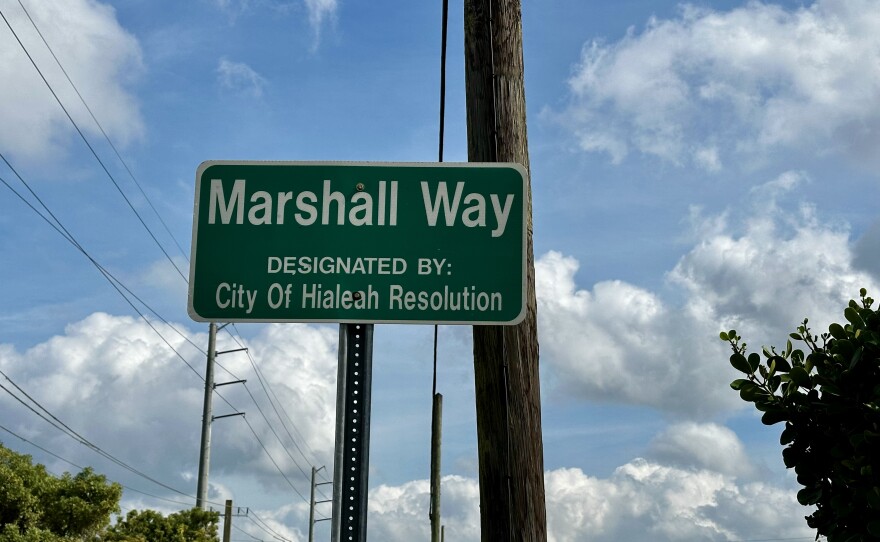


Three years before Steve’s death in 2013, the city of Hialeah and Miami-Dade County co-designated Marshall Way — named after Steve Marshall Sr.
Bovo was a Miami-Dade commissioner at the time, and was the co-sponsor of the street renaming.
The family is now advocating for a historical marker to be placed in front of the Marshall home, on Marshall Way.
“After my grandfather passed, I guess I kinda morphed into a role, I can't replace him, but kinda his position of keeping things going with the family,” said Dennis, “ I’ve been an active participant in making sure that our history is known.”