

The Smithsonian's new exhibit, “Puro Ritmo: The Musical Journey of Salsa,” is full of music and movement.
Visitors can listen to hits like Quimbara by iconic Cuban singer Celia Cruz while looking at legendary mambo artist Tito Puente’s timbales, or learn salsa dance moves from 8-foot tall interactive screens. The exhibit at the National Museum of the American Latino — part of the prestigious Smithsonian complex in Washington, D.C. — highlights salsa’s afro-cuban roots, the genre’s impact on American music, and multiple South Floridians.
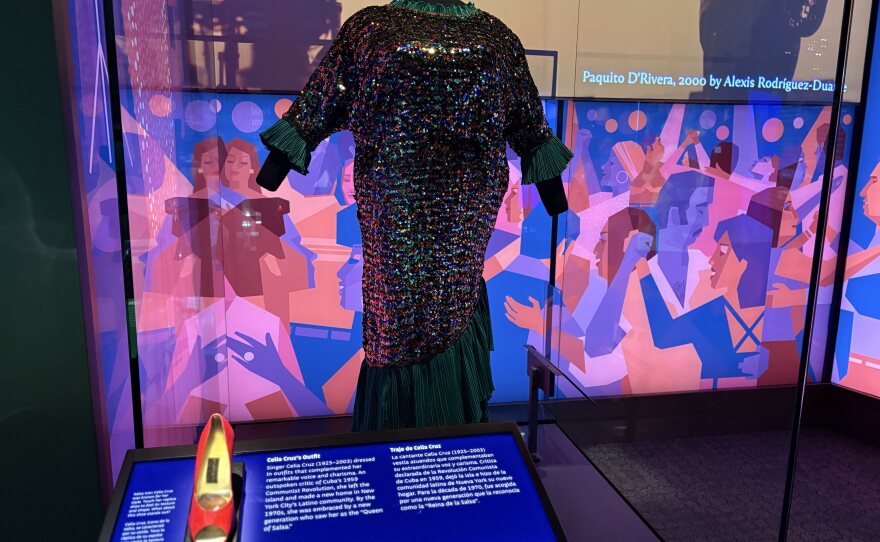
During the exhibit’s two-and-a-half-year-long run, five of Cruz’s dresses will be on display rotationally. There’s also a pair of shoes that belonged to the Queen of Salsa, which the museum has made a 3D printed replica of as well. The singer, who died in 2003, lived mainly in New Jersey after leaving Cuba in the 1960s but was a frequent visitor to Miami.
“Celia was not allowed to return to Cuba, so every time she came to Miami, she felt like she was in connection with her people,” said Omer Pardillo, the executor of Cruz’s estate and the singer’s manager during the last decade of her life.
READ MORE: A concert as grand and bold as The Queen of Salsa: An orchestral tribute to Celia Cruz
Salsa music emerged in the 1960s, influenced by earlier genres like mambo and Latin jazz. It became widely popular in the 1970s and 80s, going beyond the Caribbean Latino communities that introduced the genre to the United States.
“It’s not just other Latinos that have made this music their own, but Americans of all stripes,” said Ranald Woodaman, the curator of the exhibit. “Jewish Americans, Italian Americans, you have African Americans that, for instance, in a place like Washington, DC, were the ones that really introduced the mambo craze.”
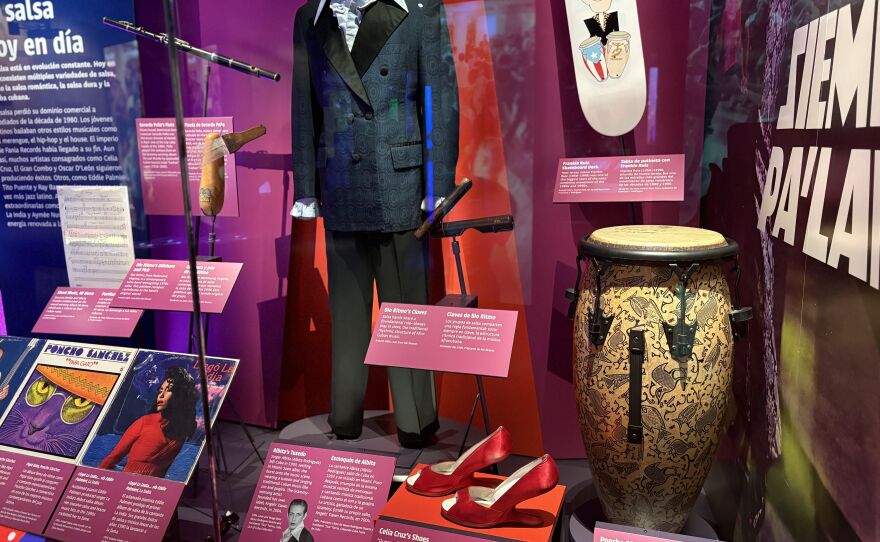
Kendall resident and salsa musician Gerardo Peña agrees. He became a professional musician at 14 and his antique French five-key flute is on display at the exhibit. While modern metal flutes have mostly replaced wooden flutes like Peña’s, the instrument remains a key instrument in charanga music, an Afro-Cuban genre that falls under salsa.
He played that flute at the Arsht Center for Grammy-winning Miami salsa artist Cachao, who helped popularize Latin music in the United States and was one of the pioneers of the mambo genre.
“[Cachao] also told me a lot of times, ‘Do not let our tradition die…just play our music and you will do very well,’” Peña recalled.
“Kids today, they think that we're only about reggaeton,” he added. “No, we have a tradition that goes way back to the 19th century. It's a blend of European, Aboriginal, and African that became the sound of the Americano Latino.”
Miami salsa singer Albita’s tuxedo is also on display in the exhibit.
Salsa and Santería
Salsa is based on a five-beat Afro-cuban rhythm called clave. When Caribbean musicians playing clave-based styles like son, rumba and mambo migrated to American cities like New York, they collaborated and influenced each other, laying the foundation for salsa.
Woodaman said that many major salsa musicians in the 20th century were initiated in Santería, an Afro-Cuban religion whose sacred music influenced salsa.
“Afro-cuban, Black Caribbean perspectives play a major part of this music, especially when you look at who have been the innovators,” he said.
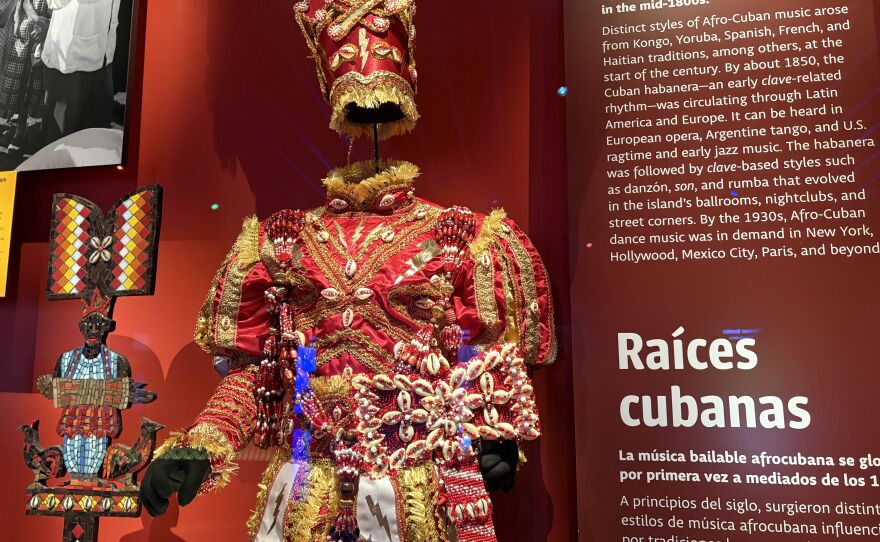
Three members of South Florida’s Santería community made regalia for the exhibit that honors the deity of drumming and dance, Changó. The outfit was sewn together by Alexander Fernandez, a ritual specialist in Santería and a professor of religious studies at FIU, alongside Martin Tsang and Esaie Desrosiers.
“All of our deities, all of our Orishas, dance. They all have their sacred rhythms very specific to them by name, within the collective of the sacred batá rhythms, the drums that are played,” Fernandez said. “But all that is under Changó's umbrella.”
They created a red and white garment with a large beaded necklace and a beaded double-headed axe. The entire ensemble is made with hundreds of cowrie shells and thousands of glass, wood and metal beads.

Grammy-winning Miami musicians Tony Succar and Aymée Nuviola are featured in the exhibit, but not through items on display. Both musicians recorded interactive videos, which are now playing on the exhibit’s 8-foot-tall touch screens, where visitors can learn about key instruments in salsa music.
Succar, who lives in Kendall, has been playing the timbales, a percussion instrument commonly played in salsa, for 30 years.
“Salsa music has been around forever, and it’s here to stay,” he said. “It’s music from the people, the pueblo… It gives it that substance that the genre needs to reach the hearts of the people.”
The National Museum of American Latino is relatively young, having been created by Congress in 2020. The museum’s founding director is Miami native Jorge Zamanillo, who was previously Executive Director of the Museum of Miami (formerly HistoryMiami Museum).
Zamanillo grew up playing in salsa bands in Miami.
“What's so important about this exhibit is that it really gives us an opportunity to use this gallery to showcase just… one topic that we're going to cover in a larger museum,” he said. “And it shows you how in-depth we can go just with salsa, not merengue, not anything else, just showing how that story is so important to our culture.”
While the museum is fundraising for a permanent building, it’s located in a temporary gallery in the National Museum of American History. “Puro Ritmo: The Musical Journey of Salsa” will be on display until November 2028.
Hazael Rojas, the studio manager of Miami Baila dance studio in Little Havana, said it’s important for people to learn about salsa’s positive influence.
“I think salsa will never die,” he said. “It’s too powerful, it is too motivating… It just feels good.


