

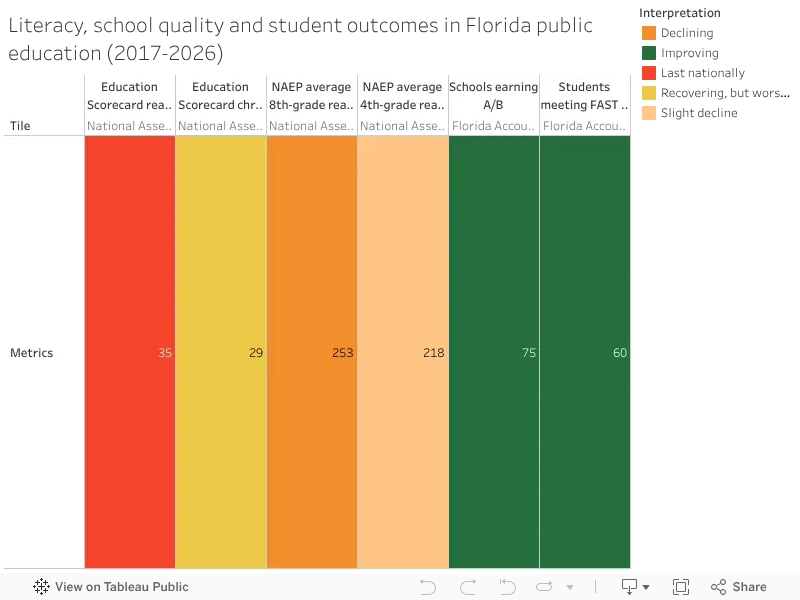
Florida gives its public and charter schools annual letter grades. This year, the most ever received an A or a B.
But at the same time, recent studies show students statewide are falling behind in reading and math compared to their national peers.
That has some parents and experts concerned about a system that requires a score of 62% or higher for an A in elementary schools and 64% in middle and high schools.
It's all based on a formula that includes standardized test scores, learning growth, graduation rates and accelerated course enrollments.
In 2025-26, 76% of Florida public schools received A's and B's on that report.
But Patricia Levesque, an education policy expert who served in former Gov. Jeb Bush's administration, cautions that there's a clear disconnect between school grades and student outcomes.
"We've lowered the bar in our school grading scale," Levesque said. "If all schools are A's or B's, there's not much positive pressure to keep improving."
The Florida Department of Education did not provide a formal response to multiple requests for comment for this story by deadline.
State and national results tell different stories
The 62% threshold for elementary schools has been consistent since 2014, but it wasn't until 2022 that the state launched the Florida Assessment of Student Thinking, or FAST.
At a June press conference in Polk County, Gov. Ron DeSantis touted the 2025-26 school grades as the best year in FAST's four-year history.
Districts administer the multiple-choice test three times a year, and results are a central component of the Department of Education's yearly school gradebook.
"Florida did not become the Education State by accident," DeSantis said. "We had to change the policy to embrace progress monitoring, and that was the right decision."
He announced that 60% of Florida public school students met grade-level FAST benchmarks for english language arts and mathematics.
ALSO READ: Florida ranks last in reading, warns nationwide education report
However, the most recent survey from the Education Scorecard, a Harvard-Stanford research collaborative that maps student achievement across the country, showed Florida last in academic growth for reading between 2022 and 2025.
Additionally, chronic absenteeism is significantly worse than it was before the COVID-19 pandemic.
However, Department of Education officials have pointed to a specific result in the National Assessment of Educational Progress (NAEP), which compares states in math, reading, science and writing proficiency at various grade levels.
A DOE spokeswoman previously told WUSF that "Florida actually outperformed the nation and ranked in the top 10 in Grade 4 reading performance in 2024."
A single year's result, however, doesn't show the full picture. Back in 2017, Florida ranked even higher, at fifth, for NAEP reading scores in Grade 4. Meanwhile, in the same period, NAEP eighth- grade reading scores fell from 25th to 43rd.
The average Florida student now is more than half a grade level behind their counterparts three years ago.
Local results paint "apples-to-oranges" pictures
This year, Hillsborough, Pasco, Sarasota and Pinellas county school districts all earned an A; what's more, Hillsborough and Pasco saw three of their D schools jump at least two levels.
Hillsborough County Deputy Superintendent Shaylia McRae said comparing those state and national standards is an "apples-to-oranges" situation, and she highlighted lower-achievement schools' monumental progress.
"This has been a stellar year for us," McRae said. "We're proud of everybody working together to get to this point."
McRae credited the district's Transformation Network. Launched in 2020, the specialized division focuses on support plans for specific students and working to fill teacher vacancies in the county's most consistently underperforming schools.
Hillsborough also honed in on college readiness, implementing the Cambridge Advanced International Certificate of Education diploma in every high school. Students who complete the program qualify for free tuition at some Florida public universities.
Next year, though, schools will need to score between 3 and 5 points higher to get an A. Florida Statute 1008 requires the State Board of Education to raise grading standards if 75% of schools get an A or B the previous year.
McRae said next year's planned higher benchmarks will challenge districts to pour even more hard work in to FAST testing numbers and school grade metrics.
"If you're always changing the goal post and you're always refining the standards, it makes it hard to get into a rhythm," she said.
History, politics and education
High-stakes testing has a long, controversial history in Florida.
In 1976, Florida became the first state to mandate a graduation test for high schoolers. A federal lawsuit challenged that requirement's constitutionality, but the state successfully argued if a curriculum was "equitable," kids weren't entitled to a diploma.
Bush went on to introduce the comparatively more rigorous Florida Comprehensive Assessment (FCAT) in 1999. That test began tying elementary school funding and closures to student scores.
After a brief alignment with Common Core standards in the late 2010s, the state implemented FAST in 2022. At the time, DeSantis claimed the new system would reduce testing time by 75%, but teachers' unions argued it would do the opposite.
Damaris Allen is a former Hillsborough County district parent and current executive director of Families for Strong Public Schools.
Allen observed that school grades tend to increase during election years due to changes in a formula the Board of Education uses to weigh all the school grade factors.
"They don't change the actual test, but they often change how grades are done," Allen said. "The challenge is that once they start doing better, they increase the standards."
The head of Florida's largest teachers' union agrees.
Florida Education Association president Andrew Spar said the grades often don't align with what outside research shows about Florida public education.
The union is currently challenging Florida's private school voucher programs in court, contending the state disadvantages public schools through underfunding.
Spar pointed out that private schools aren't subject to the same high-stakes testing requirements, which he said disrupts learning and degrades curricula.
"Schools that receive taxpayer money through the voucher program are not required to take these assessments," Spar said. "If we're saying we need accountability, shouldn't that follow the money?"
In 2024, the DeSantis administration paused funding for the New Worlds Scholarship Accounts, which partially cover the costs of math and reading tutoring for public elementary schoolers.
Most recently, state Rep. Robin Bartleman, D-Weston, proposed to pilot a six-week foundational reading course for Grades K-2. The bill died in committee.
A parent's view
Kallie Roberts, a Pasco County parent, isn't so convinced the tests actually measure student success and learning progress, and she says they create unnecessary stress at a young age.
"I know where they shine, and their test scores do not reflect their strengths — or their weaknesses," Roberts said.
At the end of each year, Wesley Chapel Elementary School holds a celebration for students who "leveled up" from their previous FAST test scores. In 2025, Roberts' daughter, who has cerebral palsy, was two points away from meeting that mark, so she couldn't participate. Roberts said such events creates a hypercompetitive school culture where kids' value comes from one end-of-year test.
At the same time, Roberts' older son has dyslexia and struggles with test anxiety — previously, he scored low on FAST, but he got a 5 this year. Roberts doesn't think that score reflects his actual reading comprehension.
"I also don't want him to use his test score as a reason why he doesn't need to work as hard," Roberts said. "Changing the FAST test to make Florida look better is a disservice to all the children in this state."
Allen echoed Roberts' concerns that the structure of high-stakes testing does not accurately reflect student mastery — since teachers must tailor lessons to the three checkpoints, kids have limited ways to demonstrate knowledge and talent.
"The way our state has it set up right now is to make kids really good at gathering information and regurgitating it," Allen said. "We have sacrificed a lot in the name of testing. How are they falling in love with reading literature if they never actually get to hold a book? They just have to read a blurb on a screen."
Allen acknowledged the work that went in these rankings, but she cautioned against too much optimism about the Florida government's investment in public education.
"Our schools are consistently doing more with less," she said.
Copyright 2026 WUSF 89.7


