


Some teachers leave indelible marks on their students, giving them lessons they’ll never forget.
One such class project stuck with Charlotte Sevilla. She remembers April 6, 1976, the day when her class buried a time capsule at May Sands Elementary School in Key West.
In celebration of America’s bicentennial, Sevilla and her classmates were tasked with preserving items that felt representative of the time period. Unlike the typical book report or math assignment, Sevilla, who was 10 years old at the time, could not shake this project.
“ I had that in my mind for 50 years, that we were gonna open this time capsule, so I was like, ‘I gotta make sure that I'm there for that,’” she said.
The students delivered four letters — one to the school principal, the Monroe County School Superintendent, the mayor of Key West and the Monroe County public library. Each one contained instructions on how to find the time capsule 50 years later.
In the letter, the students said they wanted to "leave some evidence of 1976 that may not be found in history books."
READ MORE: Diving for history: A Black genealogist's search for slave shipwrecks on Florida's ocean floor
“She's teaching you more than just putting things in there to think about the year that you're in and how far into the future it may go, but it brings everybody back to a location and a space,” she said.
That lesson brought Sevilla back to Key West prior to the open date, just so she could remind the local library of the time capsule’s existence. In an era before computers and cell phones, she was afraid of the letters getting lost to time. In fact, only three of the four letters survived.

The map, which was found in the archives of the Florida Keys History Center, led to what used to be the school’s bicentennial garden, just four feet from the school building and just six inches underground. They dug up a gallon-sized glass mayonnaise jar encased in concrete.
After so many decades underground, most of the items were largely intact and well preserved.
“I've seen a lot of time capsules over the years and, a lot of them just — they don't survive. Nature just has its way of destroying things. But in this case, the things that came out were just beautiful,” said Corey Malcom, the lead historian for the Florida Keys History Center who helped find one of the four letters. Malcom, along with the Key West Mayor, the Monroe County Schools Superintendent Edward Tierney, the Montessori May Sands School Principal and some of former students were in attendance for the time capsule’s retrieval in the spring.
Inside, the students left advertisements for the latest technology on the market, including an RCA Color TV, Ford’s Mercury Marquis and a Pulsar electronic digital watch. A cassette tape contained a ghostly recording of the students reciting all 50 states of America, followed by hit songs of that year such as KC and The Sunshine Band’s The Way (I Like It) and Barry Manilow’s Mandy. Clippings of endangered species that were native to Florida, nodded to the ongoing ecological movement of the 1970s.
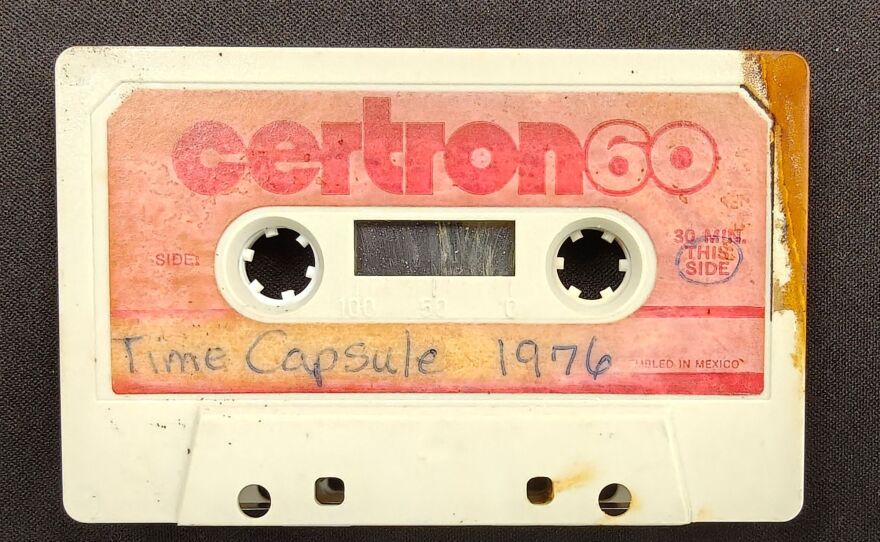
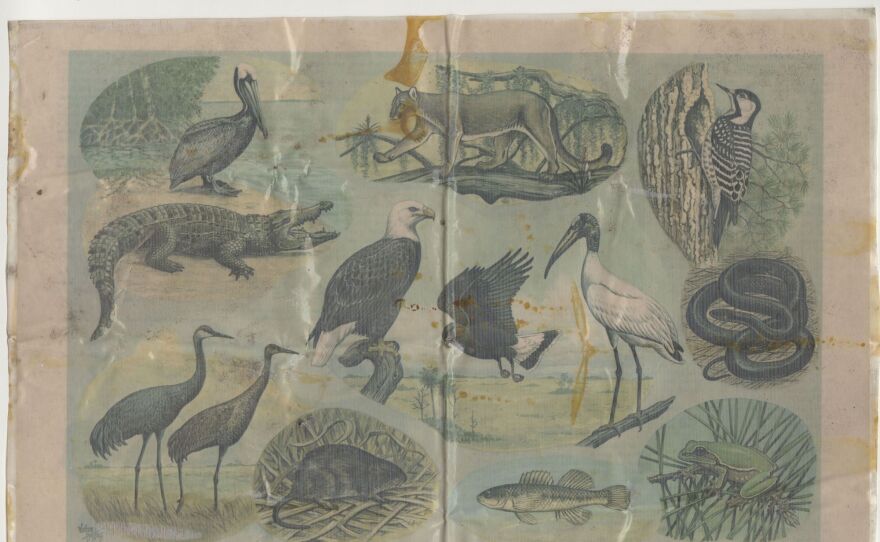
“ It seemed completely normal to us to put the [photo] slides in there and to put a cassette tape in there. Now, my daughters and my grandchildren have no idea what a cassette tape is,” Sevilla said.
The tape has been digitized and posted on the library’s website. And, per the request of the students, all of the items have been put on display at the Key West Library. While it might be convenient to write off time capsules as junk, Malcom says there’s a lot to learn from them.
“These things were important to these students at that time, and they wanted to send us a message — what it was like to be a Key West kid in 1976 and some of the issues of the day that they faced, and they just wanted to share that,” Malcom said.
In the decades since the time capsule was buried, Sevilla has traveled, built a career as a CPA and raised a family based in Miami. Uncovering the time capsule felt like pressing pause.

“ Going back as a 60-year-old compared to being in the little garden playing as a 10-year-old. You're like, ‘Oh my God, where did the time go?’”
Now the baton has been passed to the current students of what is now May Sands Montessori. They will bury their own time capsule — this time it will be opened in 25 years.
As physical media has been largely phased out by streaming and digital media, the evolution of technology poses a challenge for future time capsule creators.
“You're probably gonna be better off putting things that are physically written and physical objects. I worry about people sticking a bunch of USB drives into a time capsule, and they pull them out and either they've failed or they're just not playable anymore,” Malcom said.
Because if there’s anything to be learned from the May Sands time capsule, it’s that technology changes — fast.


