Sign up for WLRN's Soccer Edition newsletter for World Cup stories — beyond the scores.
On Deerfield Beach, the volleyball courts are packed on the weekends. As early as 9 a.m. players are bumping and spiking until well into the afternoon.
But on a seaward court, right near the lifeguard tower, the net drops a little below regulation height and no one is playing volleyball. Instead, they’re playing footvolley, a skillful Brazilian game that combines volleyball with soccer moves. Players pass the ball with their feet, chest and heads, often sending the ball over the net with an arcing overhead kick.
It's a common sight on the beach some locals call Deerfield de Janeiro — a clear sign of how the Brazilian community has left its mark on Broward County.
READ MORE: Florida human rights organizations issue tourist travel warning ahead of FIFA World Cup
“You're looking at the pier: on the right side it's American, the left side is Brazilian,” says Junior Sandara, one of the local footvolley aficionados. “It's funny because you go to the right side and they're really quiet, and if you just cross the pier, the left side, there's a little samba, a little footvolley... it's loud!”
Sandara was part of the surge of Brazilian immigration to South Florida in the late 90s and early 2000's. He arrived in 1998, joining his sister who had emigrated a few years earlier. Many Brazilians settled in the northern Broward cities of Coconut Creek, Deerfield Beach and Pompano Beach.

Today scores of Brazilian businesses line the commercial corridors of those cities. The trademark green and yellow flags fly in the windows of salons, insurance agencies and coin laundries. Restaurants serve traditional fare like the national dish, feijoada topped with farofa, and bars offer ice cold beer in tall cylindrical towers for the whole table.
“ I would say by 2010 there were already so many businesses that you could get anything Brazilian you needed in terms of food items, trinkets and media — all those things,” said Renata Bozzetto, a Brazilian deputy director at the Florida Immigrant Coalition.
Official counts say there are nearly 25,000 Brazilians living in Broward. Bozzetto, who wrote her doctoral thesis on the Brazilian community in Broward and Palm Beach Counties, says that’s probably an undercount as many don't mark their nationality on Census forms.
She says South Florida became a Brazilian hub after inflation and economic stagnation pushed many out of the country in the 1980s.


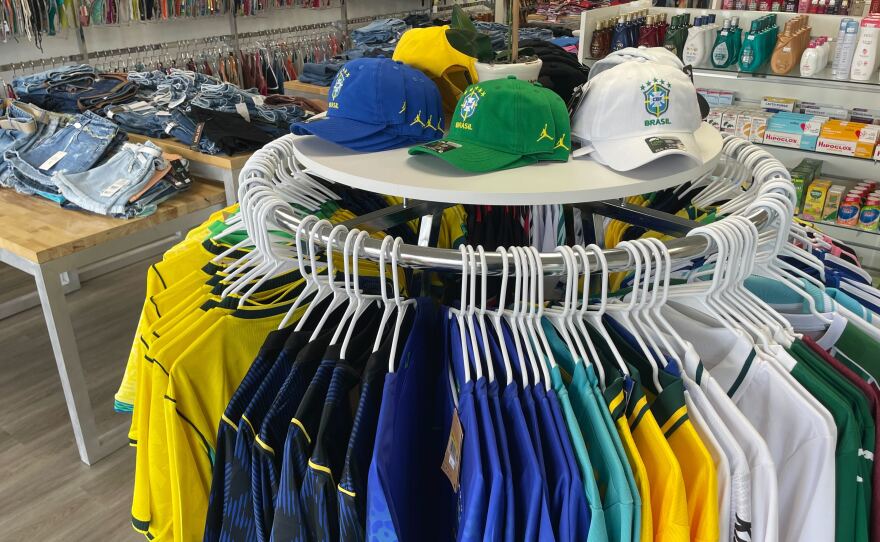
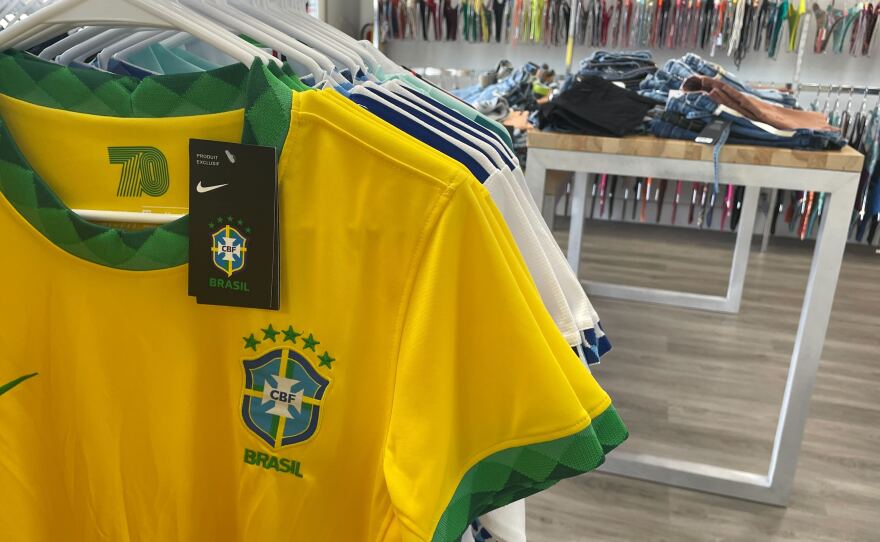
Those people mostly immigrated to the northeast, to cities like Boston and New York, where sizable communities remain. But eventually, tourism and warm weather enticed many of them to South Florida — with northern Broward appealing for its low cost compared to Miami as well as plentiful jobs in the hospitality and building industries. As is often the case with diasporas, at some point chain migration took hold with new arrivals gravitating to a place where a community already exists — as was the case with Sandara.
Bozzetto moved to Palm Beach Gardens when she came to the U.S. in 2004. She recalls that when she first heard about a Brazilian bakery in Pompano Beach, she had to drive down to check it out immediately. She now lives in nearby Boca Raton and can appreciate herself what it means to be near your culture.
“ There are moments in which you miss something, you miss a food item, or you wanna hear music,“ she said. “Having this sense that I can still have a little bit of my culture near me does give people comfort.”
Fear and ticket prices
Part of that culture is soccer — with its marquee event, the World Cup, holding an almost mystical quality for the nation. Accordingly, when Brazil hosted the tournament in 2014, Bozzetto flew home to take in the festivities. She remembers vividly the excitement that took over the country.
" The streets are painted, the flags are up, businesses are shutting down early so everybody can watch it," she said.
She was expecting the same atmosphere to take hold among the community in South Florida as this summer's World Cup approached. But the excitement has not materialized despite Brazil playing at least three games on the East coast, including one in Miami. Her work with the Florida Immigrant Coalition has given her an insight into why.
“ I think that Brazilians have a very deep connection to soccer, and this excitement could also be here in Florida. But I am scared about some of our community members who may be at risk with excessive immigration enforcement and security that may come with the World Cup,” she said.

Speaking to CBS News last week, Secretary of Homeland Security Markwayne Mullin said that U.S. Immigration and Customs Enforcement (ICE) officers would be present at World Cup games. While he said ICE would not “round up mass individuals,” he refused to rule out the possibility of immigration arrests at the games.
"ICE always does immigration enforcement," he said. "We're always going to do that — but we're not there for solely that purpose. We're in there to do our job: immigration custom enforcement."
The statements contradicted those of Rodney Barreto, chair of the Miami FIFA World Cup Host Committee, who said earlier this month that Secretary of State Marco Rubio assured him ICE agents were "not going to be at the stadium." Despite calls to do so, FIFA has not called for a moratorium of ICE enforcement at matches this summer.

It's the reason Bozzetto will not attend this summer's World Cup. “Absolutely not. Unless FIFA puts explicit rules that will protect those around me, I am absolutely not participating in the same way. It's sad,” she said.
Immigration crackdowns are not the only deterrent to attending World Cup games. Prices for Brazil’s lone match at Hard Rock Stadium against Scotland start at nearly $1,700, while the traditional powerhouse team, for the first time in decades, is not among the favorites to win the tournament.
”It's too expensive, the ticket. Really expensive… You know what? I didn't hear of any of my friends going to the game,” says Sandara, the footvolley enthusiast.
Sandara, who is the sports director at the First Brazilian Baptist Church in Pompano Beach, has a fond connection to soccer from his childhood in Brazil. He moved around a lot with his grandparents and it would be difficult for him to make friends — until he found the local pitch.
“I would say, ‘Okay, where's the soccer field here?’ I was there asking, ‘Can I play?’ ‘Oh, yeah, you can play.’ So boom, that's it. The next day, I had like 20 friends,” he said.
Sandara is working to set up World Cup watch parties at the church for other community members who can’t afford tickets. But he said he won’t be there when the games take place. He’s volunteering with FIFA for all of the games in South Florida. He won’t risk missing out.