

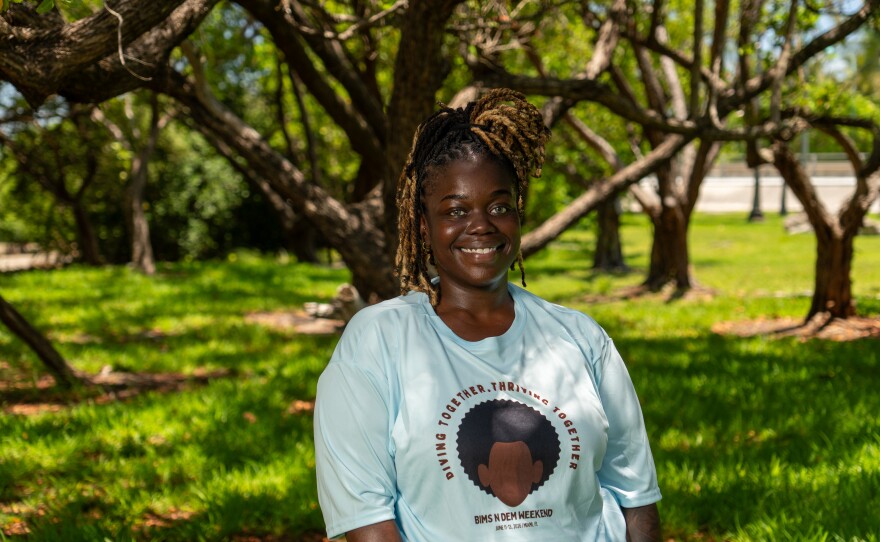
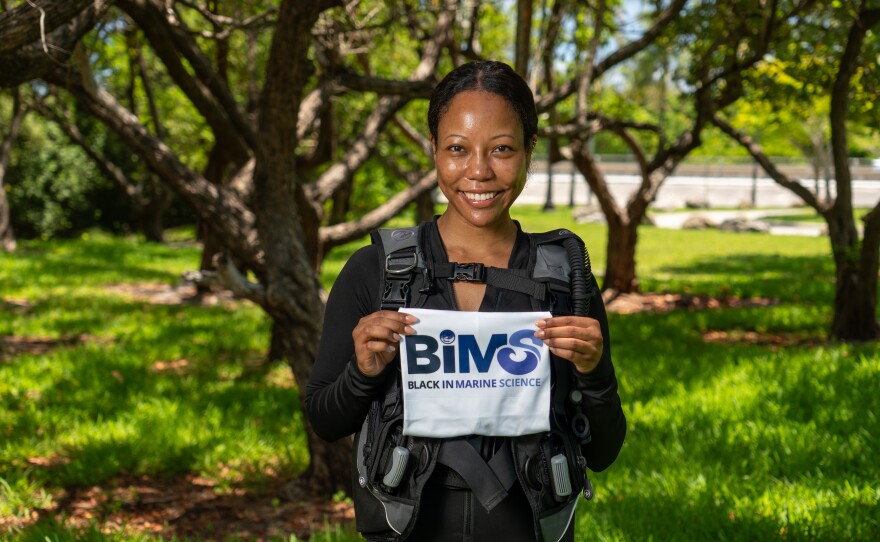
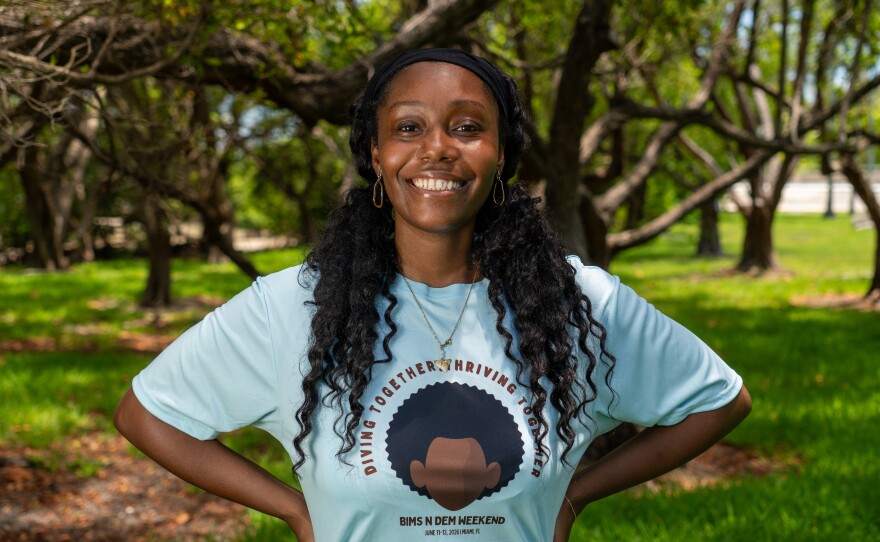
Members of Black in Marine Science (BIMS) fastened the straps of their scuba gear before plunging beneath the surface of the ocean. Their mission wasn’t to explore coral reefs — but to help restore them.
The divers with BIMS, a global nonprofit network of Black ocean scientists and marine enthusiasts, joined the University of Miami's Rescue a Reef program to plant nursery-grown corals along the Florida Reef Tract.
Within the last several years, due to climate change, marine life has been experiencing a prolonged heat wave with no end in sight. Rising ocean temperatures have led to the functional extinction of staghorn and elkhorn corals throughout South Florida.
On the boat, India Walker, 35, stood on the sidelines, watching as divers gathered their gear. She had flown from Georgia for the restoration effort.
“Coral reefs are the first line of defense when hurricanes come,” She said, “You need them.”
In South Florida, coral reefs often act as natural barriers that protect shores during hurricanes. According to a Nature Climate Change study, Black communities in states like Florida, Virginia and Texas will likely see a 20% increase in flood risk by 2050.
This is a reason why coral restoration is vital to Dr. Nikki Traylor-Knowles, professor of marine biology and ecology at University of Miami’s Rosenstiel School and founder of Black Women in Ecology, Evolution, and Marine Science (BWEEMS).
“Many Black and brown communities have more vulnerability to storms,” Traylor-Knowles told WLRN. “Coral restoration can help mitigate some of those challenges. Even here in Miami, reefs are being tested to help mitigate against storm surge."
Yet despite the high stakes for these communities, Black marine scientists remain significantly underrepresented in the field.
“ You don't usually see people like us doing things like this,“ Walker said.
Underrepresentation in marine science
According to a study released by The Oceanography Society, less than 2% of graduates and only 1% of tenured faculty in Earth, atmospheric, and ocean sciences identify as Black. The reasons for the disparity range from steep financial barriers, lack of access to the field, and discrimination and racism.
Traylor-Knowles is among that small group of tenured faculty — as the first Black professor to earn this academic status at the Rosenstiel School. But this experience can be, at times, isolating.
“That is challenging if you're in an environment where you feel isolated. People don't even sometimes realize that [comments are] racist,” She told WLRN,
“Comments about where people are from, or what their education was like. You know you're not getting the same respect because you don't sound or look like everybody else.”
This has become even more challenging amid crackdowns on diversity initiatives and scientific research studies.
Last year, President Donald Trump signed an executive order directing federal agencies to eliminate diversity, equity and inclusion programs and positions. The move sent shockwaves through universities — many of which quickly dissolved their DEI programs.
Following this executive order, the University of Miami removed all DEI resources from their online pages, prompting criticism from student organizations at the Rosenstiel campus. Among these organizations were the Umiami FL Ocean Advocacy Team and the Marine & Atmospheric Science Honors Society.
In Florida, Gov. Ron DeSantis has recently signed into law a ban on public funding for DEI initiatives.
READ MORE: DeSantis signs Florida law banning local DEI funding, says white men are 'disfavored'

For Traylor-Knowles, this onslaught of anti-DEI legislation is not just affecting student resources, but it’s also affecting scientific research.
Anti-DEI legislation and the sciences
“They’re already cutting medical related grants,” Traylor-Knowles said, referring to thousands of National Institutes of Health research grants that have been terminated over the past year.
“The funding landscape has shifted. In many grants you need to write what are called your broader impacts. And now it’s a game of wordsmiths. You can’t mention certain words.”
This game of wordsmith has caused Traylor-Knowles to become increasingly cautious about using terms such as "climate change" in grant proposals, despite it being one of the primary drivers of coral death.
“I had a grant rejected that had amazing reviews but I know it’s because it was about climate change and we had a lot of international collaborators [in the proposal],” she said.
"There may be people reading [proposals] that aren't scientists and have a political agenda. Whereas as a scientist, I have no political agenda. I just wanna help save corals."
Despite these proposal rejections, Traylor-Knowles continues to be at the cutting edge of coral research. Recently, her lab found that putting the cells of young coral into adult corals made them grow and regenerate quicker.
“We’ve only done one big experiment” She told WLRN, “We really wanna see if that was just a fluke or maybe it’s real.”
Equitable representation in marine science

Expanding diversity within marine science could lead to more breakthroughs like this, according to Traylor-Knowles.
“I think we’d make a lot more discoveries a lot more quickly,” she said, “We’d also know when things don’t work a lot more quickly because we’d be working with folks living where these corals are — not just scientists in their ivory towers.”
As divers climbed back onto the boat, the mood remained hopeful. While some BIMS members danced to R&B music that played through a speaker, others spoke about what they saw on the ocean floor.
“I loved seeing the coral nursery. The fun part was just seeing the fish swim through the coral,” Ashley Summerall, 33, said while drying off. “I feel like they were telling us thank you. You know? Like, we're helping rebuild the neighborhood.”
As the boat turned back toward shore, the newly planted corals remained below the surface. For diver Lizzie Jones, this restoration effort was deeper than corals.
“I think there’s something really cool about the regenerative process of corals, and the regenerative process of Black Americans discovering their love of the ocean," she said.


