

Walking through what remains of Temple Beth Tov, there are packed boxes filled with old prayer books, bare walls that once held religious plaques and a small flag with the Star of David on the floor.
The unassuming white and blue building on 8th Street was once a beloved synagogue in West Miami. Late last year, the temple began the formal legal process of dissolving as a religious institution. As its congregation mourns and searches for solace in its community — scrolls, memorial plaques and Torahs are in a period of transition.
Beth Tov started as a Jewish community center in 1956 in to serve a thriving Jewish community. Just a few years later, 8th Street would become Calle Ocho as one of the nation's most vibrant Cuban-American communities formed just down the road — Little Havana.
READ MORE: Broward arts groups ‘rethinking our entire existence’ as state DEI funding ban looms
But as Jewish families established new homes in other parts of Miami-Dade County over the decades, Beth Tov’s membership became older and smaller — particularly after the pandemic outbreak in 2020.
The congregation held its final service during the High Holidays that September.

“As the age of the congregation got older and after COVID, it became very difficult for the temple to really function as an active temple,” Michael Feldman, the temple's court-appointed receiver, told WLRN.

“Temple Beth Tov has never simply been a building, it has always been like a family, generation to generation,” said Rabbi Fred Klein of the Greater Miami Jewish Federation.
“To close a synagogue is always bittersweet, and I share in their sorrow. My prayer is that the sense of belonging the members found at Temple Beth Tov will continue wherever their Jewish journey will lead them.”
How to "dissolve" a synagogue
Feldman has worked alongside temple leadership over the past year to ensure the building’s closure reflects the congregation's values while preserving its history.
He is responsible for making sure religious paraphernalia like Torahs and prayer books are properly disposed of.
Three of the four Beth Tov Torahs were donated to the Greater Miami Jewish Federation, where they will be passed on to other congregations, while one Torah will receive a genizah, a Jewish burial.

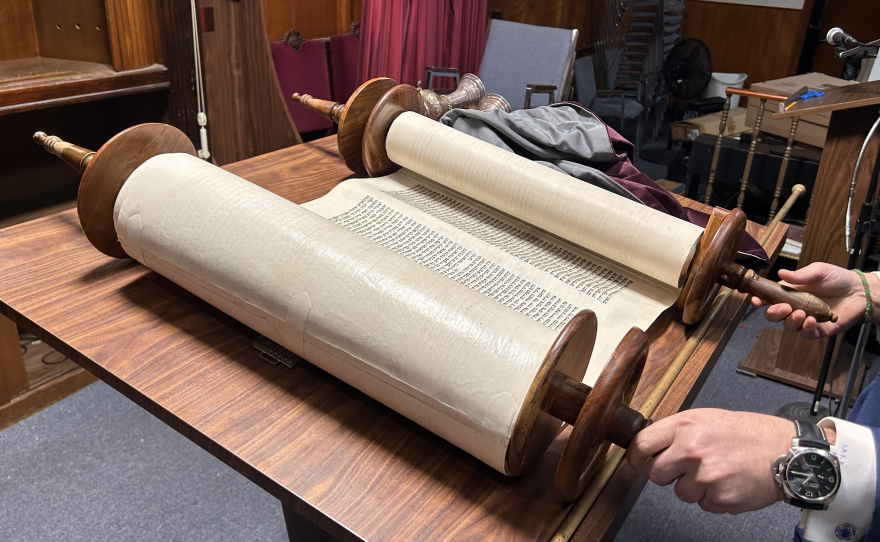
“We had a rabbi who's also a sofer who has expertise in evaluating Torah scrolls, and he was able to come and open up the scroll and look for specific things,” Feldman said, as he showed WLRN the last remaining Torah in the temple.
Feldman removed the ceremonial covers and ornaments, unfurled the large, yellowing scroll and laid it on the altar. “Like over here, there's this letter [that]'s almost, like, ripped. That would be one reason why it's no good anymore, it couldn't really be fixed.”
Elsewhere across the temple there were plaques on the floor, plates and paintings in boxes, and prayer books marked for donation. While explaining what would go where, Feldman remembered another discovery he made in the office of the temple’s longtime rabbi — 93-year old Rabbi Manuel Armon.
“ I came across this big, like, Ziploc bag package that said, 'burial plots,'" he said. It turns out the temple had bought burial plots in Jewish cemeteries for its congregation members. All the plots were in use so he didn’t have to worry about disposing of that particular asset.
A more difficult endeavor has been the 963 memorial plaques that used to adorn the walls. The plaques were bought by Beth Tov families over the years to memorialize their loved one who had passed away. Feldman and his team have contacted relatives but only 25 plaques have been claimed. He hopes that more people will hear about the temple’s closure and claim the plaque. Feldman said those that aren’t claimed will be donated to a Jewish museum.

Moving forward
Rabbi Klein has been part of the process of helping the Beth Tov community mourn and memorialize their beloved temple.
“The synagogue is the expression of the families, their spiritual values, the things that they carry in their hearts with themselves. So one of the things that I hoped that our federation could do is perpetuate the values of that community and what was important to them,” he said.
“I know from the members themselves that they feel that the synagogue had a very large impact on who they are as Jews, and we wanna honor that,” he added.
No final plans have been made for exactly how Temple Beth Tov will be memorialized. The building is in the process of being sold, and soon the last Torah will be buried.
“The essence of the synagogue is the community itself, and the memories and those families, and that's the most important thing. We have an idea in the Jewish tradition — ‘Where does God reside?’” Klein said. “Buildings may come and buildings may go, but families and the traditions —one generation to the next — that is something that I think keeps us alive as a people.”
If you would like to inquire about the Beth Tov memorial plaques, contact KHL Law at 305-854-9700, ext. 218.


