

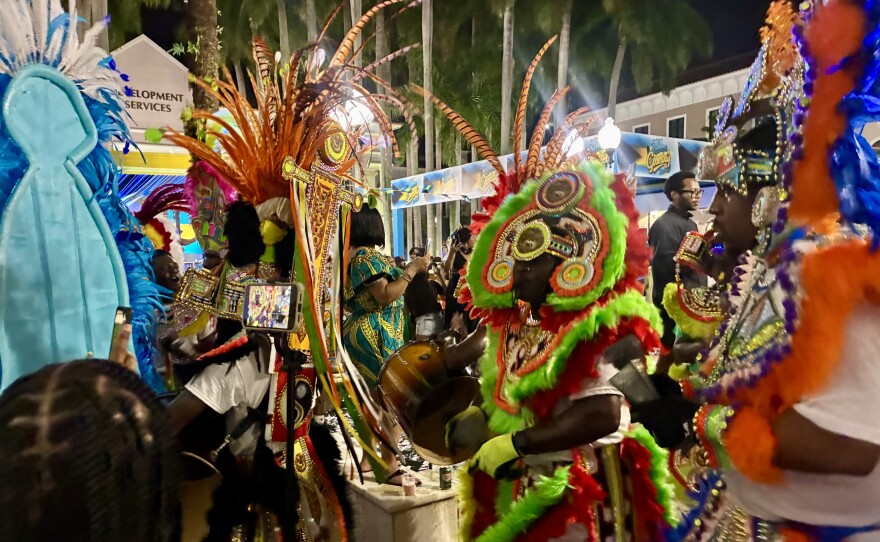
A plume of red and white feathers cascade down the back of parade leader, Tenova Wright. As she directs a procession of drummers and dancers through the plaza, the rhythms of cowbells and Goombay drums mix together with cheers from the jubilant crowd.
Over the weekend, the city of Miramar hosted its first ever Goombay festival, bringing the celebration of the Bahama’s rich history and heritage to the city for the first time.
“The minute you hear those drums,” Wright said, catching her breath after the parade, “It’s so infectious. It’s something that takes you to another place.”
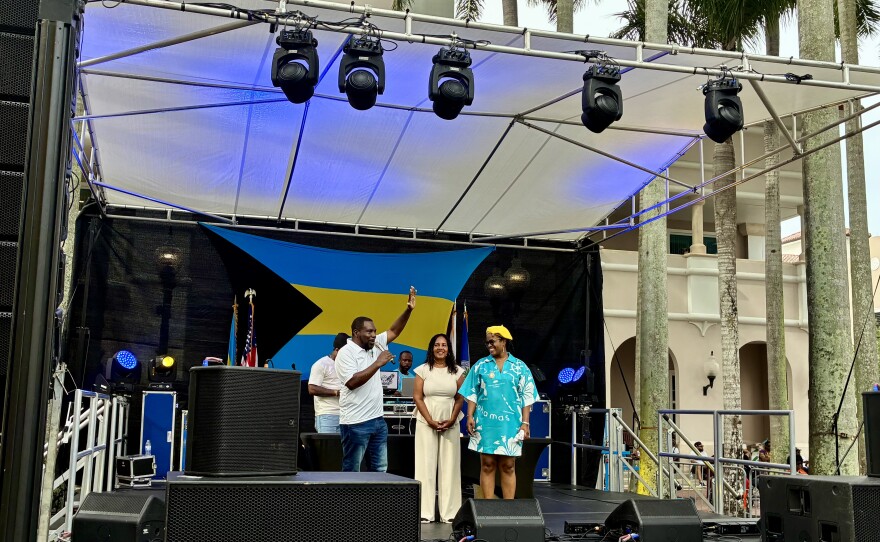
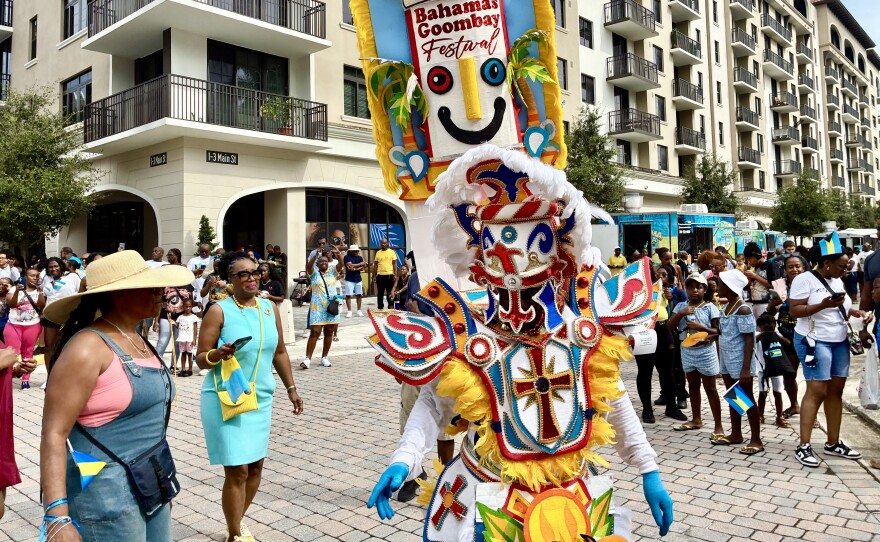
On Saturday, Miramar's city hall plaza was filled with Junkanoo street parades, rake-and-scrape music, conch fritter contests, “a Goombay village”, and history lessons.
As the sun set on Miramar, Bahamian artists came to the center stage preforming rake-and-scrape music — a traditional Bahamian sound birthed in the 1800s that's defining instrument is a carpenter's handsaw.
During the Goombay celebrations, founding member of the Grammy-award winning Baha Men, Isaiah Taylor was honored by the city of Miramar.
The group is often credited with popularizing the sounds of Junkanoo and Bahamian music to a global audience. Festival goers applauded as the group's hit song, "Who Let the Dogs Out" played.
How it all started
The festival's origins reach back to the Coconut Grove neighborhood, where the first Bahamian migrants settled on the land in the late 1800s, before Miami was an incorporated city.
Like the migration of Bahamians to Miami, this festival too has gone northward, landing on Miramar, a city with a large Caribbean community.
Commissioner Avril Cherasard, who brought this festival to Miramar for the first time, believes that this Goombay is an extension of that rich history.
“ Cultural events like Goombay helped settle the Bahamians who came to South Florida,” said Cherasard, who emigrated from Nassau, Bahamas, as a teenager.
“It helped to create that community that let them remember their roots in The Bahamas. This is really an expression of us being us, not us translating our culture.”

Goombay festivals like these traditionally feature a Junkanoo parade, where musicians and dancers march through the streets in intricately decorated costumes.
“One has to be dedicated to his art to complete [a costume],” Junkanoo performer Ronnie Cash said.
“This is originally from the Bahamas. And the drums that you hear came across the Atlantic Ocean. The drums are from Africa.”
Junkanoo was a practice born in the times of slavery, when enslaved Bahamians were allowed a brief respite from forced labor during Christmas time.
Often in the December months, enslaved people would gather what was available to them; creating horns from conch shells and costumes from readily available materials.
This tradition still informally lives on in the costumes of performers, who craft Junkanoo parade outfits from a range of materials–including cardboard, beads, and crepe paper.
“The material is expensive, and then again, the material is very cheap,” Cash said, “We bring everything together to display Junkanoo at its highest level.”
Goombay's expansion to Miramar
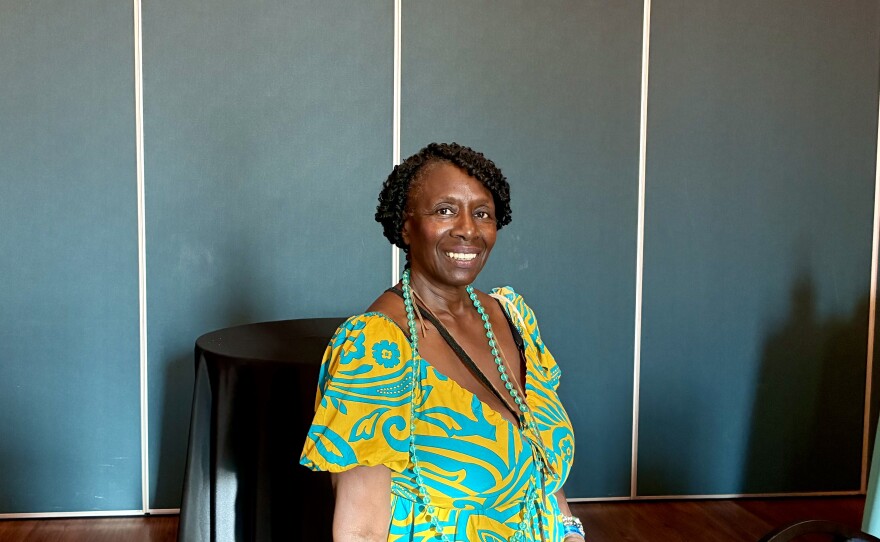
Third-generation Bahamian, Gwendolyn Sears Delapine, watched the Junkanoo band play on the side lines. Though she has been going to Goombay for over 50 years, she believes that this celebration in Miramar is one of the best she's seen in a while.
“We would take the family, the kids to Goombay [in Coconut Grove]. And then they started with the gentrification,” She said, “Now, it’s less than a quarter of what it used to be. But, I think the environment here is more inviting.”
In Miramar, Bahamian flags were festooned onto the city hall building. Commissioner Cherasard made remarks about how proud attendees should be of their Bahamian roots, whether they were "first generation Bahamian or eighth."
“The city commission is here.” Sears Delapine said, “I don’t think Coconut Grove right now makes that effort."

The West Grove, also called “Little Bahamas”, has seen an increase in displacement. In 2017, Black residents in the historic neighborhood filed a federal housing complaint saying that they were forced out of their homes unfairly. 162 residents in the neighborhood said they had been subject to gentrification and discriminatory policies.
READ MORE: Can a revived Goombay stand on its own?
Despite this, festival goer Frederica Jean-Louis-El, emphasized the importance of the festival in Miami.
“The one in Coconut Grove is much smaller, but I love it because it’s the first Goombay.” She said, “To me, this means home. It means celebration.”
Sears Delapine agreed with this sentiment.
" I think the culture is spreading out," She said, "And so I think they should have a Goombay festival in every town."
After the parade ended, the musicians continued beating their drums in the parking lot. Standing nearby was Wright, who reflected on the true meaning of Goombay for her.
" It's about taking somebody away from the day-to-day stresses," She said. " This is how we express ourselves. This is what we do to continue to be who we are, which is Bahamian."


