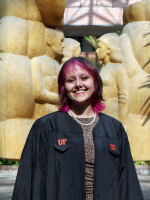
From her family's migration to Cuba, to being in a body cast — children’s author and anthropologist Ruth Behar has turned difficult real life experiences into colorful narratives about children navigating loss, immigration and the roles tradition and culture play in their lives.
Behar first spoke with WLRN 10 years ago when at 60 she published her first novel, a children’s book titled Lucky Broken Girl. The story of protagonist Ruthie is based on Behar’s real life experiences after she and her family were involved in a bad car accident that left her in a full-body cast for over 6 months. This was not long after she had immigrated to the U.S. from Cuba.
“ I feel that I've started to understand more and more through this process what the voice of the child is,” Behar said.
“When I wrote Lucky Broken Girl, it was very much through my memories of what it was like to be 10 years old and in a body cast, but in the subsequent novels, I really had to go further and kind of invent and imagine that child's voice.”
READ MORE: ‘Bodega Stories’: One author’s love letter to her parents and community
Behar has written multiple children’s stories over the past decade including Letters from Cuba, where she fictionalizes her grandmother Esther’s real-life journey of immigrating as a young Jewish girl from Poland to Cuba as the persecution of jews in Europe intensified in the 1930s.
“ Cuba was a refuge for all of these Jewish immigrants and my family always thought of Cuba as this sanctuary, as this place that gave us a home,” she said. “They were really sad when they had to leave Cuba after Castro and after the revolution, and they always spoke about Cuba in such a dreamy way and such a nostalgic way.”
Behar recently spoke with WLRN’s Sofia Zarran about Letters from Cuba, her research into Jewish-Cuban history and her own heritage. WLRN also spoke with Behar’s son, Gabriel Frye-Behar, about the latest book they co-authored called Picadillo for Paulina, a story that explores traditions and how families can learn to better accommodate one another.
“ It's kind of about respecting the child's choice, but also respecting what the family continues to do,” Frye-Behar said about the picture book, where a little girl named Paulina tells her meat-eating family that she is vegetarian.
“So the family has the tradition of eating beef picadillo, that's great, but the child wants to do something different and the family is respectful of that choice, and the child is respectful of the family's choice as well.”
Behar and Frye-Behar will be at the Miami Book Fair on Saturday to read and discuss Picadillo for Paulina.
This interview has been edited for brevity and clarity.

WLRN: Letters From Cuba follows Esther, a young Jewish girl who travels alone from Poland to meet her father in Cuba, hoping the rest of the family can follow before it's too late. The Holocaust is just a couple years behind them.
What drew you to tell it through letters specifically, and what does that format allow readers to experience that maybe traditional narratives might not?
BEHAR: After I wrote Lucky Broken Girl, I thought, "Do I have it in me to write another one?" So the letter format kind of gave me that freedom and that sense that I could do it, that it was just a letter, but it wasn't really just a letter.
Letters are very complicated forms and what I found out was that immigrants communicated through letters. That was a very common form in the late 19th and early 20th century, and historians have collected books of letters. I was able to see some of the historical letters that immigrants sent back and forth to one another, and I thought the form was so amazing.
So I had this idea that the book would be structured as letters that Esther is writing to a sister who's still in Poland.
The other thing with the story that was fun is that we tend to think of Cuba as a place that produces immigrants, people who wanna leave Cuba, but in this moment, in the 1920s and 1930s — the story's taking place in 1938 — at that moment, Cuba is a place that immigrants want to go to rather than a place they wanna leave.

Many readers may not know how deeply Cuban and Jewish history is connected. Both communities are very strong in South Florida. What do you hope South Floridian readers take away from the stories of these characters and their Jewish-Cuban identities?
So it's an identity that obviously I think about a lot, that I'm very close to. I think most people don't know that there was this important Jewish immigration to Cuba in the 1920s and 1930s, and particularly in the period between World War I and World War II.
But a lot of people came on the eve of World War II. They didn't know the Holocaust was coming, but they knew that something terrible was coming, 'cause Jews, of course, were being discriminated against in Europe at that time. And Cuba was a refuge for all of these Jewish immigrants. My family always thought of Cuba as this sanctuary, as this place that gave us a home.
I think there was something really special about Cuba, and particularly the Afro-Cuban culture I think was very receptive to Jewish people as well.
So when they left Cuba, they brought that Jewish and Cuban mix of identity and culture with them to South Florida, especially to Miami. There are at least three, if not more, synagogues that are mainly based in Jewish-Cuban communities in Miami Beach. So there's a community that kind of recreated itself in Miami because it's such a special culture to be both Jewish and Cuban, to have grown up, for example, me, with that mix of frijoles negros, arroz y picadillo on the one hand, and then bagels and cream cheese on the other hand.
That mix of cultures is just so unique and I think that we are part of the mosaic of cultures that exist in Miami, which I love so much.

So for both of you, Gabriel, what role does genera- generational storytelling play in the work that you do?
FRYE-BEHAR: I guess I've inherited that from my mom, this interest in the sense of a family story being something that helps you find your own identity, and then you have to kind of put your own individual perspective and spin onto that.
My mom and her family's lived experience: immigrated from Cuba when she was a kid, and my grandparents were in their 20s. Growing up in Michigan, I had a completely different life experience than they did, but I hope that I can still pull from things and learn from it, either from the stories that they've told me or just from how they go about their lives.
And then Ruth, now you're a mother and a grandmother. These stories are about young girls learning from their parents. How does it feel being able to share these stories with your children and your grandchildren?
BEHAR: I'm really, really just so into intergenerational conversation, understanding those who came before us, holding on to cultural memories moving forward, 'cause you're always moving into a new future. We can't replicate the past, but holding on to the stories, the values, the struggles that those before us had and made it possible for us to exist in the present.
I think that connection between past and present, history and cultural memory, is so important to me, and I'm glad that it's important to Gabriel. I'm really curious to see what our granddaughters are going to pass on.
For a South Florida audience, vegetarian or not, Cuban or not, what would you want them to take away from Picadillo for Paulina?
FRYE-BEHAR: The “Nana” character based on my grandmother, the way that she finds common ground with her granddaughter is thinking that the core part of the dish can actually just be made vegetarian. That's like the big kind of moment that is like a light bulb for both of them. That they can actually keep a lot of their traditions and then bring it into the present.
BEHAR: You can take the sofrito from picadillo and bring that to tofu, and you've still got all the Cuban flavors, and the olives, and the raisins, and all the other stuff that you might wanna add to a picadillo. It's all still there. The core is still there, but we change from beef to tofu.
It's like being more inclusive, so kind of taking our Cuban traditions and allowing more people to join in the fun of our traditions.
IF YOU GO
What: Miami Book Fair, Picadillo for Paulina book reading
When: Saturday, November 21 3:00-4:00 PM
Where: Children’s Alley Read & Chill Lounge at 300 NE 2nd Ave
For more information, here